
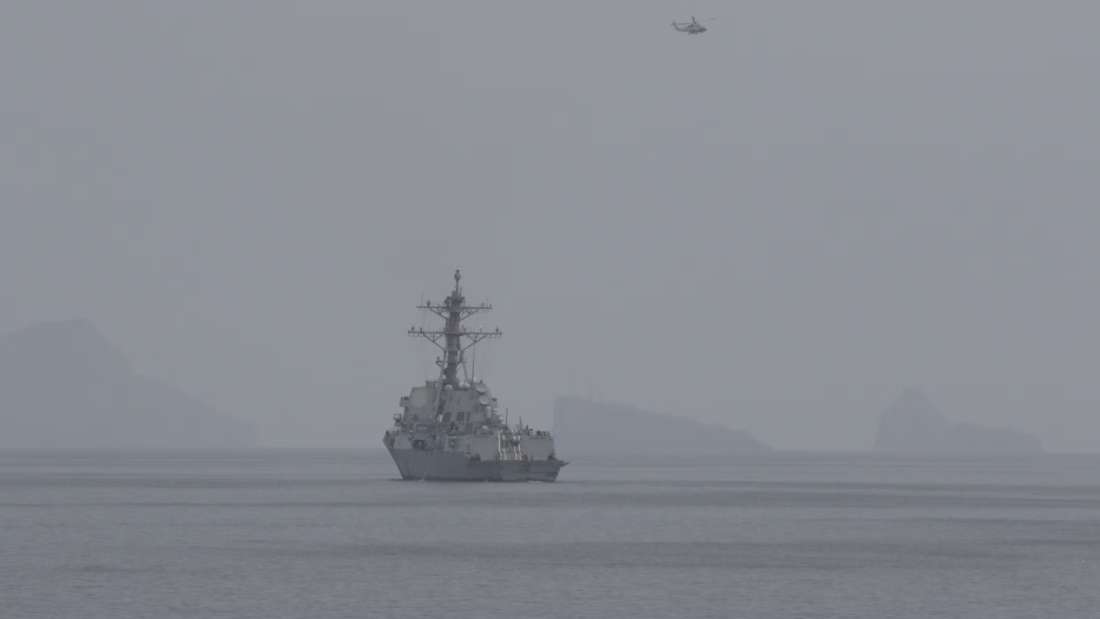
On April 11, the United States military officially began an operation to clear sea mines from the Strait of Hormuz, one of the most important maritime passages in the world. The United States Central Command, commonly known as CENTCOM, announced that its forces have started setting the necessary conditions to ensure the safe passage of commercial and military vessels. The operation is being led by two U.S. Navy guided-missile destroyers, the USS Frank E. Peterson (DDG 121) and the USS Michael Murphy (DDG 112). Both ships successfully transited the strait and are currently operating in the Arabian Gulf.
|
http://buycoffee.to/przekazwiedzy You’ll motivate me to work harder and create better content. Thank you! |

The primary objective of this mission is to remove the threat of sea mines that were deployed by Iran’s Islamic Revolutionary Guards Corps. For weeks, the presence of these explosive devices has heavily restricted international shipping in the region. The closure or restriction of the Strait of Hormuz poses a serious threat to global economic stability, as a large portion of the world's oil supplies must pass through this narrow waterway. Admiral Brad Cooper, the commander of CENTCOM, confirmed the commencement of the operation in a public statement. He explained that the military has begun the process of establishing a new, secure passage through the waters. Cooper emphasized that the military intends to share this safe pathway with the global maritime industry in the near future. The ultimate goal, he noted, is to encourage and restore the free flow of commerce that countless nations rely upon. The U.S. military also stated that specialized underwater drones and additional naval forces will soon join the effort to speed up the clearance process. The military movements are happening alongside significant political developments. Before the official military announcement, United States President Donald Trump posted on social media to declare that the clearance process had begun. He stated that the operation was being done to assist nations worldwide, including China, Japan, France, and Germany, who depend heavily on the energy resources that flow from the Middle East. Furthermore, Trump stated that all twenty-eight of the Iranian boats responsible for dropping the mines have been destroyed and are now resting at the bottom of the sea.
While the American leadership projects confidence regarding the destruction of Iranian naval capabilities, reports from regional media outlets offer conflicting stories. Certain state-affiliated news agencies in Iran dismissed the American claims of having destroyed the minelaying fleet. Furthermore, some sources aligned with Tehran initially denied that any American warships had successfully passed through the Strait of Hormuz. Despite these denials, multiple independent defense analysts and international news agencies have confirmed the transit of the USS Frank E. Peterson and the USS Michael Murphy. Intelligence reports suggest that Iran itself is facing unexpected difficulties regarding the minefield it created. Defense sources indicate that Tehran is currently struggling to accurately locate several of the naval mines it deployed during the recent escalation of regional tensions. The inability of the Iranian military to precisely track their own explosive devices severely complicates any potential efforts to safely reopen the corridor, even if diplomatic agreements are reached. Drifting and unmapped mines present a severe danger to all vessels, ranging from massive oil tankers to small cargo ships, raising the stakes for the U.S. Navy's current clearance mission.
The military operation in the Strait of Hormuz is unfolding against the backdrop of a major diplomatic effort. Delegations from the United States and Iran are currently holding direct, face-to-face talks in Islamabad, Pakistan. These high-stakes negotiations are aimed at resolving the broader conflict that has recently affected the region. The talks are taking place during a fragile, two-week ceasefire that was arranged to allow space for diplomacy. The fact that the U.S. military is actively clearing Iranian mines while diplomats negotiate directly with their Iranian counterparts highlights the complex nature of the current geopolitical situation. The destroyers leading this mission belong to the Arleigh Burke class. While these ships are primarily designed for anti-air, anti-surface, and anti-submarine warfare rather than dedicated mine sweeping, their presence sends a strong message. Defense experts note that deploying these heavily armed warships serves as a clear signal of the United States Navy's commitment to maintaining a constant presence in the waterway. They provide heavy protection for the specialized equipment and teams, such as the upcoming underwater drones, that will conduct the delicate and dangerous work of neutralizing the mines.
As the situation develops, the international community watches closely. The successful clearance of the Strait of Hormuz is not just a military victory; it is an absolute necessity for global economic health. A prolonged closure of the strait would inevitably lead to massive spikes in global energy prices, affecting everyday consumers and major industries alike. Therefore, the ongoing operation led by CENTCOM is seen as a vital step toward restoring normalcy and ensuring that the world's trade arteries remain open and secure.
What are these ships' capabilities in minesweeping?
The Short Answer: Escort and Protection, Not Sweeping. To put it directly: neither the USS Frank E. Peterson (DDG 121) nor the USS Michael Murphy (DDG 112) are dedicated mine-clearing vessels. Both ships are Arleigh Burke-class guided-missile destroyers. While they are among the most capable and heavily armed warships in the world, their primary design is for anti-air, anti-submarine, and anti-surface warfare. In the context of the Strait of Hormuz operation, their job is not to physically scoop up or detonate the mines. Instead, their role is to "set the conditions"—meaning they provide the heavy firepower, radar overwatch, and secure environment necessary for the actual, highly vulnerable mine-clearing equipment to do its job safely. If any of you have watched the TV series “The Last Ship,” this is one of the ships featured in the show.
Because mine clearance is a slow, methodical process that leaves vessels sitting ducks for coastal missiles, fast attack boats, or aircraft, you cannot send in unarmed sweepers first. The destroyers are there to act as heavily armored bodyguards, ensuring that no hostile forces can interfere with the operation.
How the Actual Clearing Happens?
While they cannot tow heavy sweeping sleds or deploy massive countermeasure arrays, these destroyers do possess a few localized tools to avoid mines:
- Kingfisher Sonar: Many Arleigh Burke destroyers are fitted with high-frequency sonar software designed specifically for mine avoidance. It looks ahead of the ship to detect moored or drifting mines in its direct path, allowing the destroyer to steer clear. It is a defensive tool for the ship itself, rather than an area-clearance tool.
- Aviation Assets: Both ships feature flight decks and hangars capable of carrying two MH-60R Seahawk helicopters. While primarily used for hunting submarines and surface ships, these helicopters can be used for aerial reconnaissance to visually spot drifting sea mines on the surface before they pose a threat to the fleet.
How the Actual Clearing Happens
Since the destroyers are providing the defensive shield, the physical work of neutralizing the minefield falls to other specialized assets. As noted by CENTCOM in the article, unmanned underwater vehicles (UUVs) and specialized forces will be joining the effort. The U.S. Navy typically relies on dedicated Avenger-class Mine Countermeasures (MCM) ships, MH-53E Sea Dragon helicopters (which tow heavy magnetic and acoustic mine-sweeping sleds through the water), and remote-controlled robotic drones like the Sea Fox, which can swim up to a mine and detonate it. The destroyers are the tip of the spear, securing the corridor so these specialized, lightly armed clearance teams can safely follow.
SOURCES:
https://www.centcom.mil/MEDIA/PRESS-RELEASES/Press-Release-View/Article/4457220/us-forces-start-mine-clearance-mission-in-strait-of-hormuz/
https://www.timesofisrael.com/us-says-navy-destroyers-working-to-de-mine-strait-of-hormuz/
https://aa.com.tr/en/world/us-central-command-says-its-forces-begin-mine-clearance-mission-in-strait-of-hormuz/3902256
https://defence-industry.eu/u-s-central-command-begins-mine-clearance-operations-in-strait-of-hormuz/
https://english.news.cn/20260412/f6dac50d7ed4400ea761d1754aba5d67/c.html
https://www.livemint.com/news/us-news/us-military-begins-setting-conditions-for-clearing-mines-in-strait-of-hormuz-after-trumps-post-11775927604849.html
https://www.naval-technology.com/projects/burke/?cf-view
https://defence-blog.com/u-s-navy-destroyers-transit-strait-of-hormuz/#:~:text=Guided%2Dmissile%20destroyers%20of%20the,%2C%20and%20anti%2Dsubmarine%20warfare.
 Polski (PL)
  English (United Kingdom)