
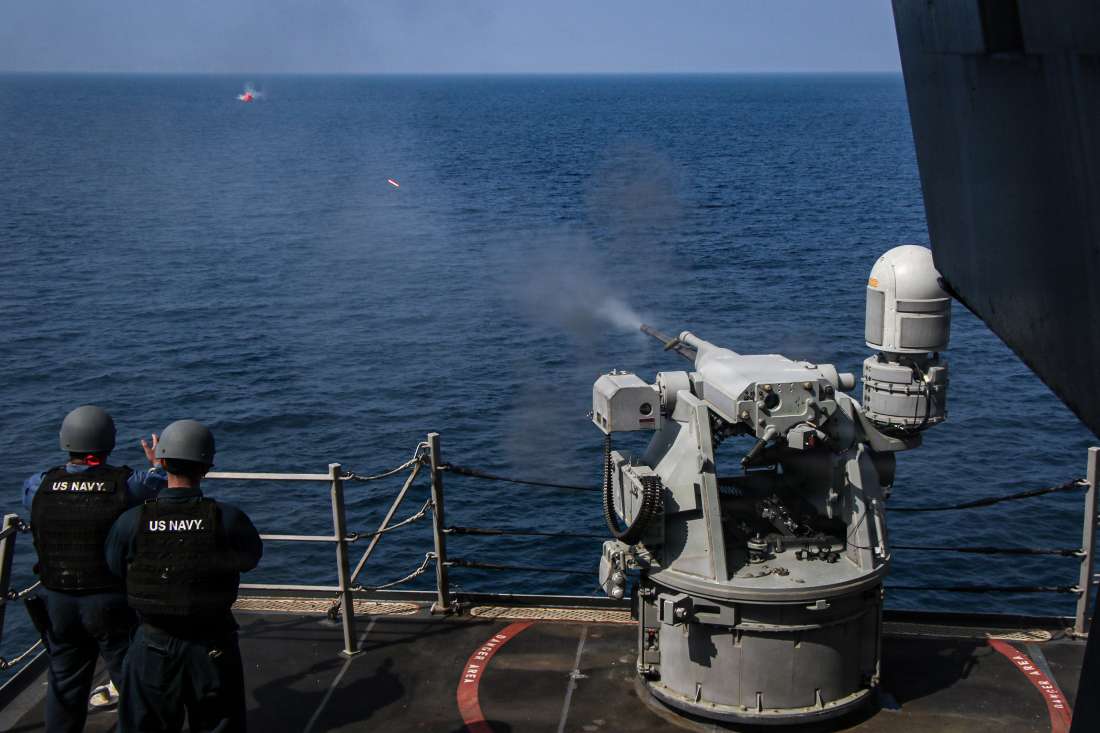
The recent footage released by the Islamic Republic of Iran Broadcasting has brought international attention to a dangerous confrontation in the strategic Strait of Hormuz. The incident involves the Islamic Revolutionary Guard Corps Navy and two United States Navy Arleigh Burke-class destroyers, the USS Michael Murphy and the USS Frank E. Petersen Jr. The footage highlights a tense maritime standoff, capturing the exact moment Iranian forces issued a stern threat to the American vessels. This event is not an isolated incident but rather a critical moment in a larger geopolitical struggle, occurring just as diplomatic negotiations attempt to secure peace in the region.
|
http://buycoffee.to/przekazwiedzy You’ll motivate me to work harder and create better content. Thank you! |

The confrontation took place as the two American warships navigated near the Fujairah Port and the Gulf of Oman, preparing to transit the heavily monitored Strait of Hormuz. Iranian state television broadcasted the audio and video of the encounter, where an Iranian naval officer can be heard delivering a stark message over the radio. The voice directly addresses the American ships, stating, "Attention U.S. Navy warship, transiting near Fujairah Port and Oman Sea; this is IRGC Navy; LAST WARNING, LAST WARNING, LAST WARNING." The repetition of the phrase underscores the severity of the threat, presenting the American vessels with an ultimatum to either alter their course or risk being targeted by Iranian forces. This military maneuver by the United States was executed with a highly specific objective. According to official statements released by the United States Central Command, the USS Frank E. Petersen Jr. and the USS Michael Murphy were sent into the region to initiate a complex mine-clearance operation. Months prior, during a period of intense regional conflict, the Islamic Revolutionary Guard Corps had reportedly laid numerous sea mines across the waterway. These mines pose a significant threat to both military and civilian maritime traffic. The American military asserted that its mission was focused on ensuring the freedom of navigation and clearing the vital economic corridor for international trade. Additional forces, including specialized underwater drones, are expected to join the clearance effort in the coming days to fully secure the route.
⚡️JUST IN
— Iran Observer (@IranObserver0) April 12, 2026
Iranian State TV released footage showing the IRGC warning American warships to leave the Gulf of Oman
The American warships left the area pic.twitter.com/QJwNBT0a4d
Despite the aggressive warnings from the Iranian forces, the United States Navy destroyers continued their designated path. Audio recordings captured by nearby civilian ships and later corroborated by international media outlets revealed the American response to the Iranian challenge. The crew of the United States ships calmly replied that their passage was being conducted in strict accordance with international maritime law. They explicitly stated that no aggressive challenge was intended toward the Iranian forces and emphasized their commitment to abiding by the rules of the ongoing ceasefire established by their government. United States officials later confirmed that both destroyers successfully transited the strait without altering their course and without any direct armed conflict occurring. The timing of this maritime confrontation is particularly notable because it coincided with crucial diplomatic negotiations taking place miles away in Islamabad, Pakistan. Delegations from the United States and Iran were engaged in marathon peace talks aimed at de-escalating the broader regional conflict that began earlier in the year. The negotiations were heavily focused on the status of the Strait of Hormuz, recognizing its critical importance to global energy supplies. The Iranian government has long maintained that it exercises full control over the waterway and recently stated that passage would only be granted to civilian vessels under very specific conditions. By sending military vessels through the strait during these sensitive talks, the United States sent a clear message that it does not recognize Iran's claim of absolute control over the international corridor.
Iranian media and officials have presented a narrative that aligns with their defensive posture. The Islamic Revolutionary Guard Corps had previously issued a public warning, stating that any military vessel attempting to pass through the strait without permission would face severe consequences, including a specific threat of being attacked within thirty minutes of entry. While Iranian state channels suggested that the American vessels retreated or faced immediate danger, the successful transit of the destroyers indicates a different reality on the water. However, the presence of the American warships undoubtedly complicated the diplomatic efforts in Islamabad, as Iranian negotiators reportedly used the incident to protest American actions during the talks. The Strait of Hormuz remains one of the most critical maritime chokepoints in the entire world. A vast portion of the global oil supply travels through this narrow passage, making it a vital artery for the international economy. Any disruption in this area, whether through the placement of sea mines or direct military confrontation, has immediate and severe consequences for global markets. The recent standoff between the United States Navy and the Islamic Revolutionary Guard Corps serves as a stark reminder of the volatile nature of the region. As the United States continues its mine-clearance operations to ensure the safe passage of commercial and military vessels, the international community watches closely. The delicate balance between asserting navigational rights and avoiding a direct military conflict will dictate the future stability of the Middle East and the success of any ongoing peace negotiations.
SOURCES:
https://www.republicworld.com/world-news/strait-of-hormuz-crisis-iran-warns-severe-punishment-as-us-navy-warships-begin-mine-clearing-operation-amid-peace-talks
https://www.trtworld.com/article/4520a24ca01d/amp
https://www.irantimes.com/news/iran-war-live-updates%3A-u.s.-and-iran-hold-marathon-peace-talks-into-the-early-morning
https://houseofsaud.com/iran-destroyer-warning-hormuz/
https://www.hindustantimes.com/world-news/this-is-the-last-warning-what-transpired-between-us-and-iran-forces-in-strait-of-hormuz-as-talks-went-on-in-islamabad-101775958421064.html
https://www.mk.co.kr/en/world/12014573
 Polski (PL)
  English (United Kingdom)