
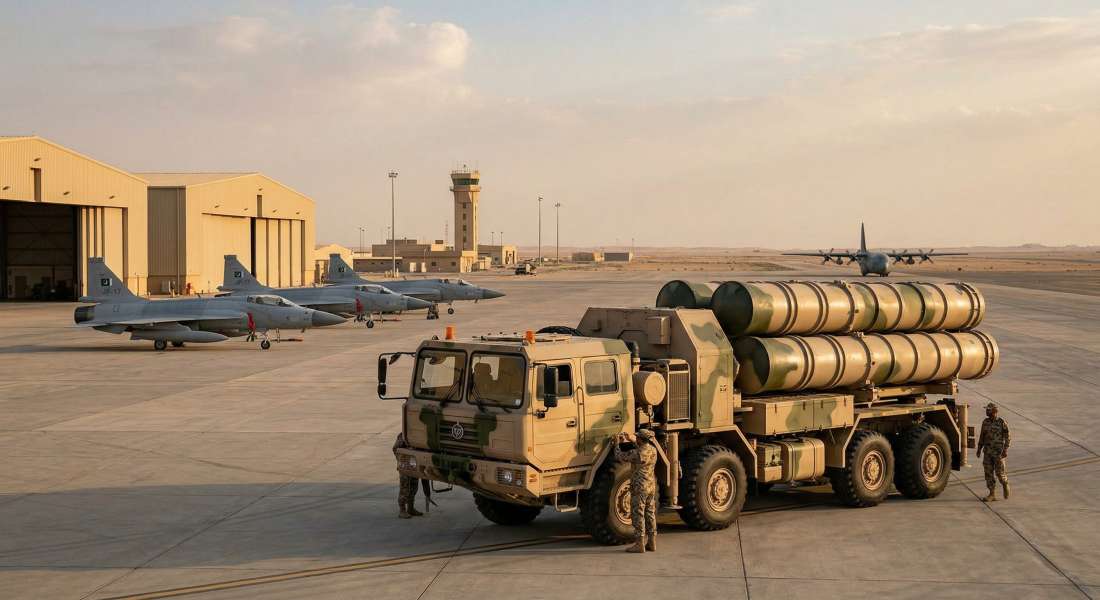
A significant military movement has recently reshaped the security landscape of the Middle East. A large Pakistani military force has officially arrived in Saudi Arabia to support the defense of the Kingdom. According to an official statement released by the Saudi Ministry of Defense, this Pakistani military contingent has safely landed and stationed at the King Abdulaziz Air Base, located in the Eastern Province. After warning from Saudi Arabia to Pakistan to act against Iran under new defence pact otherwise repay USD 6.3 Billion loan, Pakistan Army has started deploying its troops.
|
http://buycoffee.to/przekazwiedzy You’ll motivate me to work harder and create better content. Thank you! |

This deployment is not a sudden reaction but the active implementation of a joint strategic defense agreement signed between the two nations in September 2025. The official statement highlighted that the newly arrived force includes advanced fighter jets and various support aircraft. The primary goal of this mission is to enhance joint military coordination, raise the level of operational readiness between the armed forces of the two countries, and maintain overall regional stability. This deployment involves a massive commitment of personnel and hardware. Reports indicate that thousands of Pakistani soldiers, alongside modern fighter jets like the JF-17 Thunder and vital C-130 transport aircraft, have established their presence at the base. The King Abdulaziz Air Base is a highly strategic location, situated close to some of the world's most important energy facilities and oil processing plants. In recent times, these critical facilities have faced severe risks from regional conflicts and cross-border attacks. By placing a strong, well-equipped force in this exact location, Pakistan is sending a clear message of solidarity. The move serves as a powerful deterrent against any potential aggression directed at Saudi territory, especially during a time when regional peace talks remain fragile and deeply uncertain.
A critical and highly observed component of this military deployment is the inclusion of a unit equipped with the Chinese-made HQ-19 air defense system. The HQ-19 is considered one of the most advanced defense shields in the world today. For many years, the only known user of this system was the military of China. However, after finalizing a major defense agreement, Pakistan recently became the very first foreign nation to acquire and actively use the HQ-19. Its unexpected presence in Saudi Arabia introduces a completely new level of defensive technology to the region, drawing the close attention of global military analysts who are eager to see how it operates alongside established Western security architectures. The HQ-19 is designed with a very specific and vital purpose: to intercept and destroy medium and intermediate-range ballistic missiles before they can ever reach their targets. It operates outside the earth's atmosphere, making it a direct counterpart to the well-known American THAAD system. What makes the HQ-19 particularly effective is that it does not rely on traditional explosive warheads to destroy a threat. Instead, it uses pure kinetic energy. This means the interceptor missile simply crashes directly into the incoming enemy missile at extreme speeds, destroying it completely upon impact. The system is incredibly fast and highly capable. It can hit targets flying at speeds of up to ten thousand meters per second, and it can reach high altitudes exceeding two hundred kilometers.
When looking at the physical composition of this defense system, a single standard battery is designed to be highly mobile and efficient. A typical battery consists of two heavy launch vehicles, each built on a rugged eight-wheel-drive truck chassis. Each of these launch vehicles carries six interceptor missiles ready to fire at a moment's notice. In addition to the massive launchers, the battery includes a mobile command and control center where operators manage the local defense network. It also relies on a powerful integrated radar system that possesses a massive detection range of up to four thousand kilometers. This impressive range allows the defense team to see threats forming long before they enter the local airspace. While the HQ-19 protects the higher altitudes from fast-moving ballistic missiles, modern defense also requires a reliable solution for lower-altitude threats, particularly unmanned aerial vehicles. Therefore, it is important to accurately describe the specific drones associated with this modern military strategy. Pakistan has brought its own advanced drone technology into the spotlight, most notably the Shahpar-II Block II. This is a medium-altitude, long-endurance drone developed by Pakistan's state-owned defense industry, and it was recently showcased with great pride at the World Defense Show in Riyadh. The Shahpar-II is built for both continuous surveillance and active combat missions. It features an advanced autopilot system that allows it to take off and land completely on its own.
The capabilities of the Shahpar-II drone make it a formidable tool in the desert environment. It has an impressive endurance, capable of staying in the air for twelve to twenty hours without needing to land, depending on how heavily it is loaded with equipment. It can fly at altitudes of up to twenty-three thousand feet, quietly monitoring vast areas of land and coastline. When configured for surveillance, it uses high-definition cameras and heat sensors to provide live video to the ground commanders. When sent on combat missions, the drone is armed with four precision air-to-ground missiles. It features a highly reliable communication link that allows human operators to safely control it from over a thousand kilometers away. The role of these drones is absolutely crucial. They act as constant eyes in the sky, providing early warnings to the command centers. This helps protect the base and the surrounding energy infrastructure from smaller, low-flying dangers, such as the explosive suicide drones that have been widely used in recent regional conflicts. Together, the high-altitude reach of the HQ-19 and the constant patrol of the Shahpar-II drones create a comprehensive and layered defense shield. The arrival of the Pakistani forces, bringing in both skilled personnel and modern Chinese-designed technology, marks a noticeable shift in how security is managed in the Middle East. Saudi Arabia is clearly demonstrating a willingness to diversify its security partnerships, looking well beyond its traditional Western allies to ensure its long-term safety. For Pakistan, this deployment fulfills its strict commitments under the mutual defense pact and strengthens a deeply important economic and political relationship with the Kingdom. As the world watches these historical events unfold, the combined military force stationed at the King Abdulaziz Air Base stands as a major new factor in the global balance of power, ready to maintain stability in a rapidly changing and unpredictable environment.
A common observation among casual observers is the apparent paradox of Pakistan sending troops to defend Saudi Arabia against potential threats originating from Iran, a country with which Pakistan shares a massive physical border. However, viewing Pakistan and Iran as traditional military allies is a fundamental misconception. While Islamabad and Tehran maintain necessary diplomatic channels and economic ties out of geographic necessity, their relationship is historically fraught with deep suspicion, sectarian differences, and severe border security disputes. In stark contrast, Pakistan’s relationship with Saudi Arabia is built on decades of profound financial dependence, shared religious leadership alignments, and extensive military cooperation. Pakistan has always navigated a very delicate geopolitical tightrope in the Middle East. The country possesses a large Shia Muslim minority, making its leadership highly cautious about entering conflicts that could ignite severe domestic unrest or spark a direct war with neighboring Iran. Because of this, Pakistan's foreign policy traditionally favors mediation over direct aggression. A prominent example occurred several years ago when the Pakistani parliament voted strictly against sending combat troops to join the Saudi-led offensive operations in Yemen. Yet, there has always been one absolute, unshakeable rule in Islamabad's foreign policy doctrine: the complete commitment to protecting the territorial integrity of Saudi Arabia and the defense of the holy Islamic sites located within the Kingdom.
The current deployment of thousands of troops and the advanced HQ-19 air defense system fits perfectly within this defensive framework. By strictly framing the mission under the umbrella of a mutual defense agreement, Pakistan effectively fulfills its heavy obligations to Riyadh without officially adopting an aggressive, offensive posture against Tehran. The military hardware brought into the Eastern Province, particularly the interceptor missiles and surveillance drones, is inherently designed to protect airspace and intercept incoming attacks rather than to launch strikes into foreign territory. This careful distinction is crucial for Islamabad. It allows the Pakistani government to secure vital economic support and maintain its prestigious position as a leading military power in the Islamic world, all while attempting to prevent an outright, catastrophic war on its own western border with Iran. Ultimately, this move highlights the pragmatic and often cold reality of global military alliances. Economic survival and historical defense pacts simply outweigh the superficial ties of geographical proximity. By placing its soldiers and its most advanced defense technologies on Saudi soil, Pakistan is making a calculated gamble. The leadership hopes that a massive display of defensive strength will serve as a strong enough deterrent to freeze the current regional conflict, forcing all hostile actors to reconsider their actions before crossing lines that could plunge the entire region into an uncontrollable war.
SOURCES:
https://houseofsaud.com/pakistan-troops-eastern-province-smda-deployment/
https://themedialine.org/headlines/pakistan-deploys-troops-fighter-jets-to-saudi-base-under-2025-mutual-defense-agreement/
https://defencesecurityasia.com/en/pakistan-hq-19-missile-defense-china-operation-sindoor-south-asia/
https://en.wikipedia.org/wiki/HQ-19
https://www.armyrecognition.com/archives/archives-defense-exhibitions/2026-archives-news-defense-exhibitions/world-defense-show-2026/wds-2026-pakistan-unveils-shahpar-ii-block-ii-male-drone-with-integrated-strike-capability
https://www.livemint.com/news/world/pakistan-deploys-fighter-jets-and-military-personnel-in-saudi-arabia-amid-us-iran-ceasefire-talks-11775909571599.html
https://www.thenationalnews.com/news/gulf/2026/04/11/pakistan-sends-fighter-jets-to-saudi-arabia-as-part-of-defence-agreement/
https://www.aljazeera.com/news/2015/4/10/pakistan-parliament-backs-neutrality-in-yemen-conflict
https://www.aljazeera.com/news/2015/4/6/pakistan-debates-military-involvement-in-yemen
https://www.voanews.com/a/pakistan-scrutiny-troop-deployment-saudi-arabia/4257833.html
https://www.militarytimes.com/news/your-military/2015/04/06/pakistan-says-saudi-led-coalition-in-yemen-wants-troops/
https://www.atlanticcouncil.org/blogs/new-atlanticist/the-skies-are-quiet-but-the-iran-pakistan-strikes-left-lasting-diplomatic-damage/
https://www.iiss.org/publications/strategic-comments/2024/03/the-tit-for-tat-conflict-between-iran-and-pakistan/
https://en.wikipedia.org/wiki/2024_Iran%E2%80%93Pakistan_conflict
 Polski (PL)
  English (United Kingdom)