
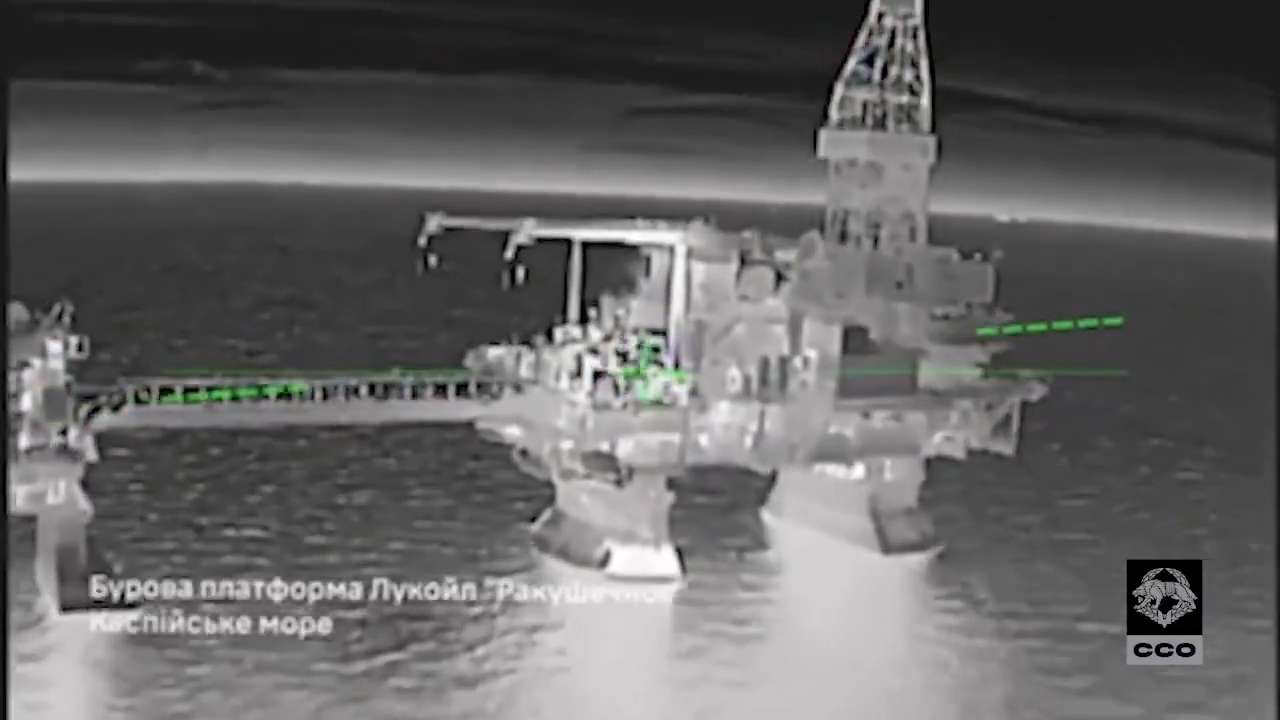
On the night of April 9 to April 10, 2026, the Ukrainian Armed Forces carried out a major long-range operation targeting Russian energy infrastructure. According to official reports from the Ukrainian military command, drone units struck two offshore drilling platforms in the northern Caspian Sea.
|
http://buycoffee.to/przekazwiedzy You’ll motivate me to work harder and create better content. Thank you! |

These facilities are owned by the Russian oil company Lukoil. The operation is highly important not just because of the chosen targets, but because of the massive distance involved. The platforms are located nearly one thousand kilometers away from the active front lines in Ukraine. This strike shows a continued effort by Ukraine to bring the consequences of the war directly to Russian economic assets located deep inside what was previously considered a safe area. The specific targets of this nighttime operation were two ice-resistant stationary platforms known as LSP-1 and LSP-2. These large industrial structures operate at the Yuri Korchagin and Valery Grayfer oil fields. The Valery Grayfer field was previously known by the name Rakushechnoye. Both of these sites are critical parts of Russia's offshore oil production network in the region. Based on statements from the General Staff of the Armed Forces of Ukraine and the Special Operations Forces, these platforms were not simply civilian business sites. They were actively used as a key part of the supply chain for the Russian military. The Ukrainian command stated that these facilities served as a vital link in providing necessary fuel and engine oil to the Russian army currently fighting in Ukraine. By successfully hitting these distant targets, the Ukrainian military has sent a clear message about its growing long-range weapons. Hitting an offshore platform at sea requires highly accurate navigation and steering systems. The drones had to travel roughly one thousand kilometers, flying past multiple air defense systems to reach the Caspian Sea waters. The Ukrainian Special Operations Forces released video footage of the strikes, confirming the successful hits on the platforms. While the exact models of the drones used in the operation have not been publicly announced for security reasons, the result proves that Ukraine's defense industry has successfully built weapons capable of reaching deep into Russian territory.
This strategy of targeting the oil and gas industry is mainly built on two major goals. The first goal is purely military. Modern armies require massive amounts of fuel to move and fight. Tanks, armored troop carriers, trucks, and combat airplanes simply cannot function without a constant and reliable flow of diesel and aviation fuel. By destroying the equipment that extracts and processes this oil, Ukraine aims to cause immediate supply problems for Russian troops on the battlefield. The second goal is financial. Russia heavily relies on selling energy to fund its military budget. When large production facilities and drilling rigs are damaged, it creates a direct cost. It limits the total amount of oil that can be taken out of the ground, reducing the overall money that the Russian government can use to pay for the war. It is necessary to view this recent attack as part of a much wider, ongoing campaign rather than a single separate event. Throughout the past year, and particularly in the early months of 2026, Ukraine has steadily focused on damaging the Russian energy sector. For instance, this is not the first time Lukoil's equipment in the Caspian Sea has been targeted. In January of 2026, Ukrainian forces also directed strikes against similar drilling platforms in the exact same region. Beyond the Caspian Sea, Ukrainian drones have recently hit an oil pumping station in the Krasnodar region of Russia and an oil terminal in Feodosia, located in occupied Crimea. All of these attacks follow the same logical idea: breaking the fuel supply chain before the fuel can ever reach the combat zones.
The long-term results of these deep strikes remain to be fully seen, but the immediate effect is a forced change in Russian defensive planning. When targets a thousand kilometers away become vulnerable to attack, the Russian military command must make difficult choices. They must decide whether to pull air defense missile systems away from the front lines in Ukraine to protect business centers and energy sites deep within their own borders. Every missile system moved to guard an oil platform in the Caspian Sea is one less system available to protect Russian soldiers in eastern Ukraine. Ultimately, the events of April 9 and 10 highlight a phase of the conflict where the entire supply and financial foundation of the Russian military effort is under constant threat.
SOURCES:
https://www.kyivpost.com/post/73685
https://understandingwar.org/research/russia-ukraine/russian-offensive-campaign-assessment-april-10-2026/
https://kyivindependent.com/ukrainian-forces-strike-drilling-platforms-in-caspian-sea-military-says/
https://newsukraine.rbc.ua/news/struck-from-1-000-km-away-ukraine-hits-russian-1775834879.html
https://unn.ua/en/news/a-strike-1000-km-from-the-front-line-the-sso-showed-unique-footage-of-the-defeat-of-russian-drilling-platforms-on-the-caspian-sea-shelf
https://www.ukrinform.net/rubric-ato/4111269-defense-forces-strike-two-drilling-rigs-in-caspian-sea.html
https://www.worldoil.com/news/2026/1/11/ukraine-strikes-lukoil-offshore-oil-platforms-in-caspian-sea/
 Polski (PL)
  English (United Kingdom)