
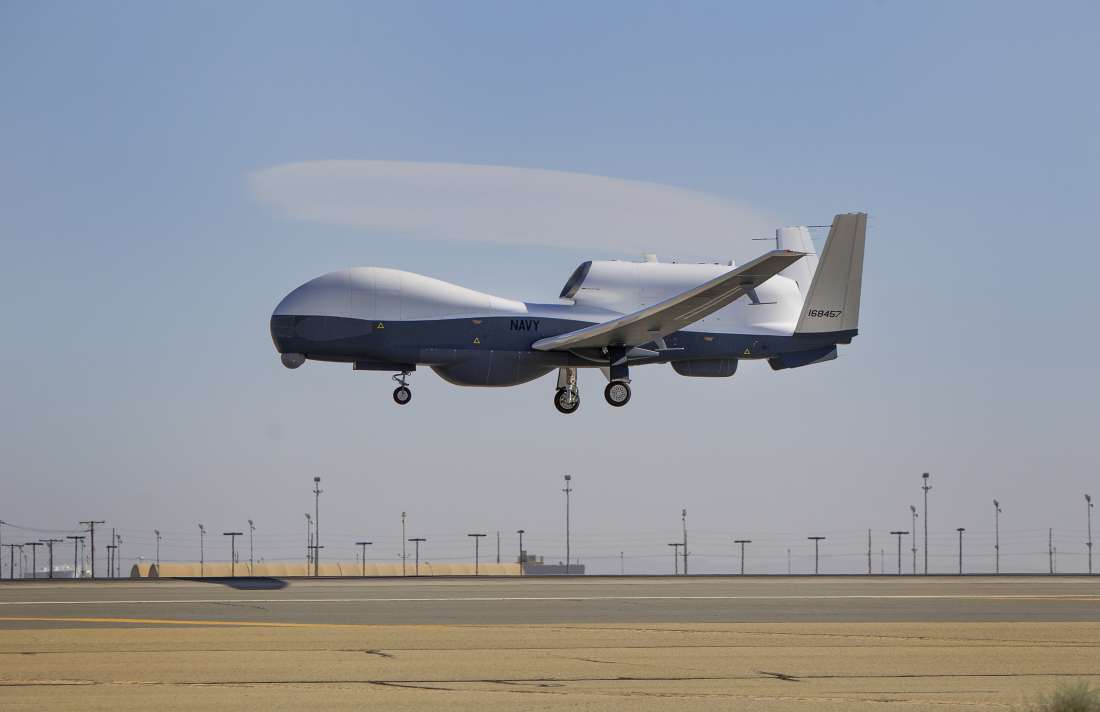
The United States Navy has officially confirmed the loss of an MQ-4C Triton, a high-altitude surveillance drone, over the waters of the Persian Gulf. This confirmation came through a standard mishap summary report published by military officials in mid-April 2026, putting an end to several days of intense public speculation and rumors on social media.
|
http://buycoffee.to/przekazwiedzy You’ll motivate me to work harder and create better content. Thank you! |
The massive unmanned aircraft, which has an estimated unit cost ranging from 238 million to 243 million dollars, simply vanished from public flight tracking systems on April 9 after transmitting a series of emergency signals. This event marks a significant financial loss for the American military and highlights the ongoing and severe risks of operating unmanned aircraft in highly contested regions of the world. Publicly available flight tracking data provides a clear picture of the aircraft's final moments. The drone had completed a lengthy, routine surveillance mission over the strategic Strait of Hormuz, a critical passageway for global energy shipments. It was on its way back to its home base at Naval Air Station Sigonella, located in Sicily, Italy. During its return flight, while cruising safely at an altitude of approximately 52,000 feet, the aircraft suddenly sent out a distress signal. Initially, it transmitted a specific code indicating a total loss of communication with its human operators, which was followed very quickly by a standard general emergency code. Within a matter of minutes, the drone experienced a rapid and uncontrolled loss of altitude, dropping out of the sky from its normal cruising height down to below 10,000 feet. At that lower altitude, all radar and tracking data completely stopped, and the drone was lost to the sea.
Interestingly, this exact type of drone, and reportedly this specific aircraft, had spent significant time operating safely in the European theater. Taking off from the exact same base in Italy, it was frequently used to monitor the ongoing conflict in Ukraine over the past four years. During countless long-duration missions in the skies near Europe, the drone performed with extremely high reliability and never reported such sudden or catastrophic communication failures. However, within a very short timeframe of operating in the tense and unpredictable environment of the Persian Gulf, the aircraft encountered a fatal issue. This stark contrast points directly to the very different conditions, and the potential presence of electronic jamming or other unseen threats, that exist in the Middle East compared to European airspace. The sudden loss of the Triton brings renewed attention to the underlying vulnerability of certain unmanned systems in modern, active combat zones. While the MQ-4C is packed with highly advanced cameras, radar, and communication sensors, its basic airframe design is quite large and not built to evade modern enemy air defenses. It flies high and slow, making it a very clear and obvious target on enemy radar screens. Even though it is considered a highly capable intelligence-gathering tool, it remains an older generation of drone technology when it comes to basic physical survival in the air. Without defensive weapons, fast speeds, or stealth capabilities, such drones are relatively easy to target if they lose their connection, drift off course, or accidentally enter hostile airspace.
Despite the massive price tag of nearly a quarter of a billion dollars, the United States military approaches the loss of these drones with a very practical philosophy. In the eyes of military planners, unmanned aerial vehicles are ultimately seen as semi-expendable assets. The core of this belief is that the most valuable part of any military aircraft is not the physical metal, the expensive sensors, or the complex engine, but the highly trained human crew inside. By using robots to perform dangerous and tedious surveillance missions over hostile waters, the military willingly accepts a certain level of equipment loss. Planners and commanders are willing to tolerate the destruction of a very expensive machine because it is, at its core, just a very large remote-controlled plane. High attrition is accepted precisely because it means that no human pilots were put at risk, injured, or killed in the event of a crash or a hostile attack. To truly put the financial loss into perspective, the cost of a single MQ-4C Triton is actually significantly higher than many of the most advanced manned fighter jets flying in the world today. For example, the price of one Triton is roughly equivalent to two highly advanced F-35 stealth fighters. However, an aircraft without a pilot is still just a replaceable flying machine. The loss of a drone results in a painful financial hit and a temporary gap in intelligence gathering, but it completely avoids the severe political fallout and the human tragedy of an American pilot being killed or captured by foreign military forces. This calculated risk remains the primary reason the military continues to send these expensive systems into danger zones on a daily basis.
At this time, the exact cause of the crash remains entirely unconfirmed by the military. The Navy has classified the event as a major aircraft mishap but has deliberately not stated whether the drone suffered a simple mechanical failure, a targeted electronic warfare attack that severed its connection, or a direct physical strike from surface-to-air missiles. The region where the drone went down is known for extreme global tension, and the incident occurred shortly after a very fragile ceasefire agreement was reached in the area between opposing forces. Various unofficial reports and rumors have suggested hostile action may have taken place, but military officials have kept the precise details hidden from the public for strict operational security reasons. The disappearance and confirmed crash of the MQ-4C Triton over the Persian Gulf serves as a clear and sobering reminder of the harsh realities of modern maritime surveillance. As nations continue to rely heavily on unmanned technology to safely gather crucial intelligence, they must also be prepared to lose these valuable assets at a moment's notice. The sharp contrast between the drone's safe years of service over Europe and its sudden loss in the Middle East shows exactly how quickly a seemingly calm operational environment can turn deadly for even the most expensive technology. Ultimately, as long as flying machines can do the dangerous work of humans, the destruction of a multi-million-dollar robot will always be viewed as an acceptable alternative to the loss of a human life.
SOURCES:
https://www.twz.com/air/navy-mq-4c-triton-surveillance-drone-crash-in-the-middle-east-finally-confirmed
https://theaviationist.com/2026/04/09/mq-4-triton-disappears-over-persian-gulf/
https://www.indiatoday.in/world/story/us-navy-confirms-mq4c-triton-drone-240-million-dollar-crash-cost-f35-jets-persian-gulf-strait-of-hormuz-iran-war-2896682-2026-04-15
https://www.twz.com/air/navy-mq-4c-tritons-fate-unknown-after-disappearing-from-flight-tracking-over-persian-gulf
https://en.defence-ua.com/news/us_mq_4c_triton_vanishes_over_persian_gulf_after_transmitting_emergency_code_7700_and_loss_of_control_first_ever_combat_loss_possible-18127.html
https://www.hindustantimes.com/world-news/us-200-million-mq-4c-triton-drone-vanishes-over-hormuz-after-distress-signal-claims-swirl-on-social-media-101775800037943.html
 Polski (PL)
  English (United Kingdom)