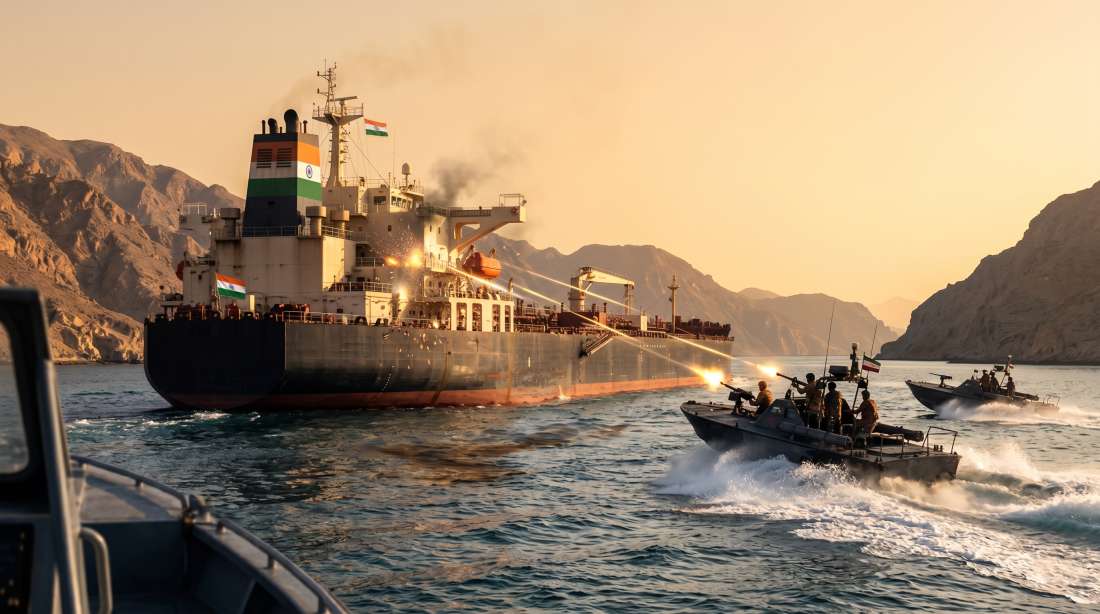
On the morning of April 18, 2026, Iranian military forces opened fire on civilian Indian vessels. This violent escalation occurred despite recent high-level diplomatic signals from Tehran suggesting that the vital waterway would remain open for commercial traffic.
|
http://buycoffee.to/przekazwiedzy You’ll motivate me to work harder and create better content. Thank you! |
The primary target of the attack was the Sanmar Herald, a massive Indian-flagged oil tanker that was attempting a routine transit through the narrow passage. Observers in the region describe the event as a significant shift in Iranian tactics, as the Islamic Revolutionary Guard Corps (IRGC) Navy acted with extreme aggression against a nation that has traditionally maintained stable relations with Iran. This incident has effectively halted the flow of energy through the world’s most important maritime chokepoint, leaving hundreds of ships and thousands of sailors in a state of high alert and uncertainty. New evidence provided by maritime security agencies includes a dramatic audio recording from the bridge of the Sanmar Herald during the height of the attack. In the recording, the ship’s captain can be heard screaming into the radio, identifying his vessel as the Motor Tanker Sanmar Herald and addressing the "Sepah Navy," which is the local name for the IRGC. The captain desperately pleaded for the Iranian motorboats to stop their fire, shouting that his crew had already received official permission to pass through the Strait. Despite these frantic appeals and the ship’s clear identification, the two IRGC high-speed boats continued to fire at the hull and superstructure of the tanker. The recording captures the total chaos on board as the crew realized that their formal authorization was being ignored by the military units on the water, forcing the captain to beg for permission to simply turn the ship around and flee to safer waters.
The Sanmar Herald is a Very Large Crude Carrier (VLCC) and represents a massive asset in the global oil trade. With a deadweight tonnage of roughly 300,000 tons and a length exceeding 330 meters, the ship was carrying a full cargo of approximately two million barrels of Iraqi crude oil destined for Indian refineries. In a desperate attempt to protect his crew and ship from further aggression, the captain changed the vessel’s identity in the Automatic Identification System (AIS). The ship’s name was temporarily broadcast as "INDIANSHIPINDIANCREW" to signal to any nearby military forces that the vessel was neutral and manned by Indian nationals. This tactical move highlights the extreme vulnerability of slow-moving supertankers when they are trapped in narrow waters and targeted by small, fast, and heavily armed military craft.
While the Sanmar Herald was being targeted by gunfire, a second Indian vessel named the Jag Arnav was also intercepted by the IRGC. The Jag Arnav is a bulk carrier operated by the Great Eastern Shipping Company and was carrying a vital cargo of urea, which is a chemical fertilizer essential for India’s agricultural sector. Although the Jag Arnav did not face the same level of direct fire as the tanker, it was surrounded by Iranian naval forces and forced to perform a complete 180-degree turn. Both ships were part of a group that believed the waterway had been reopened following the Lebanon ceasefire announcement. The forced retreat of these two major vessels has sent a clear message to the international shipping community that no commercial ship, regardless of its cargo or nationality, is currently safe from military interference in the region.
The attack has revealed a deep and dangerous split within the Iranian government regarding the management of the Strait. Only hours before the shooting, Iran’s Foreign Minister, Abbas Araghchi, had publicly declared that the Strait of Hormuz was fully open for commercial traffic as a gesture of goodwill following a temporary regional truce. However, the IRGC quickly countered this diplomatic statement with their own announcement on social media platforms. The military leadership stated that the "status of the Strait remains unchanged" and that they would continue to block traffic as long as the United States maintains a naval blockade of Iranian ports. This internal conflict between the civilian government and the powerful Gwardia Rewolucyjna (IRGC) suggests that the military has taken total control of maritime policy, effectively overriding the decisions of the Foreign Ministry and creating a highly unpredictable environment for international trade.
In response to the violence, the Indian government has launched a major diplomatic protest. The Ministry of External Affairs (MEA) in New Delhi officially summoned the Iranian Ambassador, Mohammad Fathali, to express their extreme anger and dissatisfaction. Foreign Secretary Vikram Misri personally met with the envoy to demand an explanation for why Indian sailors were put in life-threatening danger after being granted permission to sail. India has historically avoided taking sides in Persian Gulf conflicts, but the targeting of its energy and agricultural supplies has forced a much tougher stance. The MEA emphasized that India expects an immediate guarantee of safety for its ships, especially since Iran had previously described India as a friendly partner. This diplomatic rift could have long-lasting effects on the cooperation between the two nations regarding regional trade and security.
The danger in the region is not limited only to Indian vessels, as other commercial ships have also reported attacks during the same period. The United Kingdom Maritime Trade Operations (UKMTO) reported that a container ship owned by CMA CGM was hit by an unknown projectile approximately 25 miles off the coast of Oman. Furthermore, a missile or projectile was seen landing in the water extremely close to a luxury cruise ship traveling near the Omani coastline. These incidents suggest that the IRGC or their regional allies are targeting a wide range of vessels to maintain a state of fear and total control over the area. With over 20,000 sailors currently stuck on ships waiting in the Gulf, the risk of a major humanitarian or environmental disaster is growing every hour that the military standoff continues.
As the day comes to an end, the Strait of Hormuz remains effectively closed to international commerce, and the "temporary truce" appears to have failed at sea. The global energy market is already reacting with panic, as the safety of one-fifth of the world’s oil supply is now in question. Military experts believe that the IRGC is using these attacks to prove that they are the final authority in the region, regardless of what the international community or even their own government says. If a stronger international naval response is not organized quickly to protect merchant shipping, the economic consequences for the entire world could be devastating. For now, the Indian government and the international shipping community are left waiting to see if Tehran can regain control over its military forces or if the region is headed for a much larger armed conflict.
SOURCES:
https://www.thehindu.com/news/international/iran-war-live-updates-us-waiver-for-russian-oil-israel-april-18-2026/article70876378.ece
https://infra.economictimes.indiatimes.com/news/ports-shipping/tensions-rise-as-iranian-forces-fire-at-two-indian-ships-in-strait-of-hormuz/130356021
https://www.seatrade-maritime.com/security/tanker-fired-on-by-iran-in-strait-of-hormuz
https://www.tribuneindia.com/news/india/indian-vessels-shot-at-forced-out-of-strait-of-hormuz-by-iranian-navy/
https://www.hindustantimes.com/india-news/indian-tanker-carrying-2-million-barrels-of-oil-shot-at-by-iran-navy-101776515341891.html
https://www.logupdateafrica.com/shipping/iran-allows-full-vessel-passage-through-hormuz-amid-ceasefire-1358838
https://peoplesdispatch.org/2026/04/17/iran-fully-opens-strait-of-hormuz-following-ceasefire-deal-in-lebanon/
https://www.seatrade-maritime.com/security/tanker-fired-on-by-iran-in-manmar-herald-fired-upon
 Polski (PL)
  English (United Kingdom)